
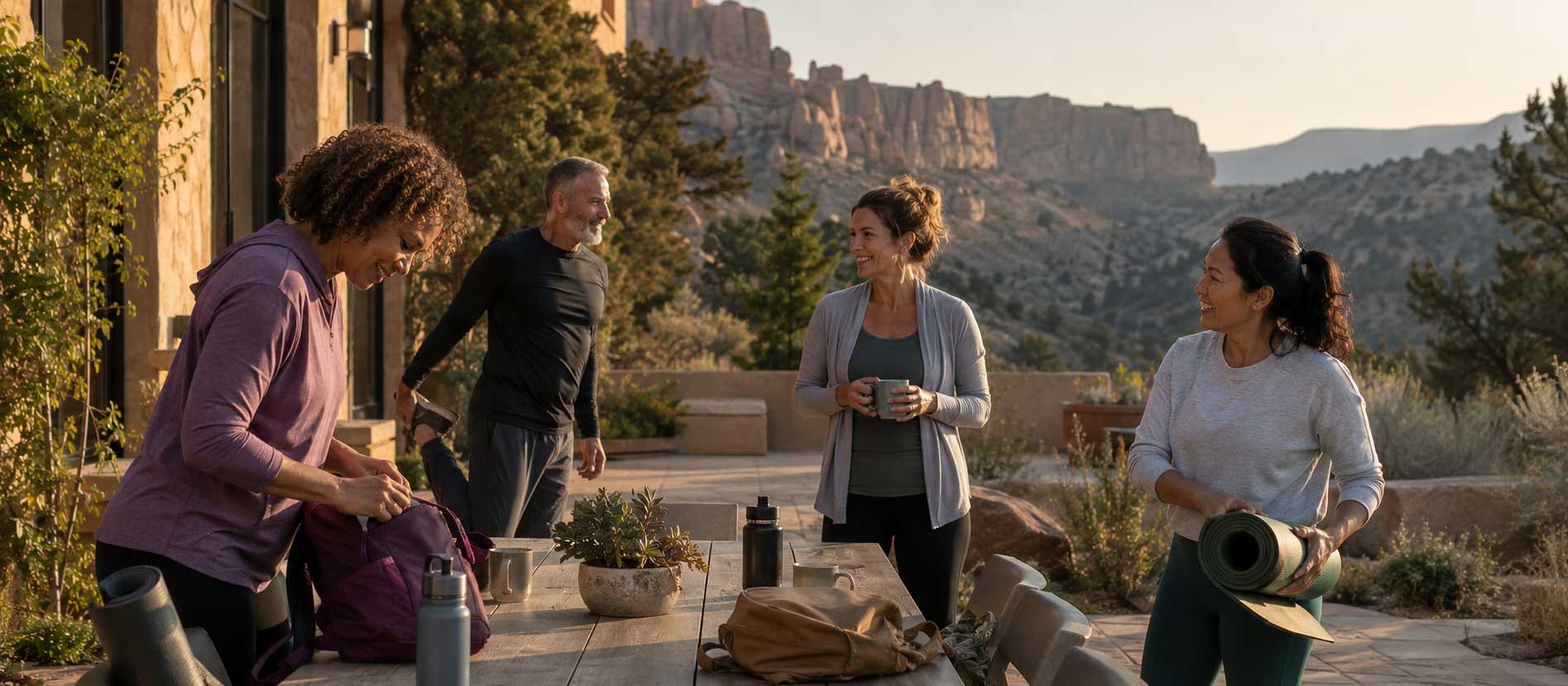
An adult fitness retreat is a residential experience built around physical activity, planned meals, recovery, and time away from ordinary routines. Depending on the program, it may also include nutrition education, personal training, health assessments, behavior coaching, hiking, spa treatments, recreational outings, or workshops designed to help guests continue healthier habits after returning home.
That definition covers a surprisingly wide range of experiences.
At one end of the market are highly structured programs where most of the day is planned, meals are controlled, workouts are expected, and measurable physical progress is a central goal. At the other are wellness resorts where fitness classes, hiking, spa services, and educational sessions are available, but guests decide how much or how little to do.
Between those extremes are smaller residential fitness retreats that combine scheduled exercise and healthy meals with downtime, recreation, social activities, and a more relaxed pace.
This variety is why two places described as an “adult fitness retreat” can feel almost nothing alike.
A week at The Ranch Malibu may revolve around morning hikes, afternoon strength work, restorative yoga, and daily massage. Mountain Trek builds much of its program around guided hikes lasting approximately 2.5 to 4 hours. Premier Fitness Camp advertises several hours of weekday training, while Movara and Weight Crafters combine scheduled activity, meals, education or coaching, recovery, and residential support within a structured weekly format.
By contrast, resorts such as Canyon Ranch, Rancho La Puerta, Miraval, Red Mountain Resort, and BodyHoliday offer extensive activity calendars while allowing guests considerably more control over what they attend. Canyon Ranch advertises more than 35 daily activities, Rancho La Puerta schedules dozens of classes alongside morning hikes, Miraval provides access to a broad calendar of fitness and wellness experiences, and BodyHoliday explicitly invites guests to do as much or as little as they choose.
Before booking, the most important step is not deciding whether fitness retreats sound appealing in general. It is understanding what a particular program means by fitness, structure, support, and retreat.
At a Glance:
What Does an Adult Fitness Retreat Actually Feel Like?
Most adult fitness retreats remove at least some of the planning that normally surrounds exercise, food, transportation, and daily scheduling.
Instead of waking up and deciding whether to work out, what to eat, or how to organize the day, you enter an environment where many of those decisions have already been made. Breakfast may be served at a set time. A walk or fitness session may begin shortly afterward. Lunch, workshops, recreation, and recovery periods may already be placed on the schedule.
For some guests, this is one of the most valuable parts of the experience. The retreat creates a temporary environment in which movement and healthier meals become the default rather than something that must be negotiated around work, family, errands, and household responsibilities.
That does not mean every retreat is rigid.
Some programs expect the group to move through the day together. Others give you a menu of classes and allow you to create your own itinerary. Some provide a schedule but describe every activity as optional. Cal-a-Vie, for example, schedules guests for full days of fitness, meals, spa treatments, and other activities while stating that participation is optional. Rancho La Puerta and Miraval operate more like extensive wellness campuses, with many simultaneous choices rather than one mandatory group track.
The atmosphere can also vary.
One retreat may feel like a small adult summer camp, with communal meals, group challenges, and strong social bonding. Another may feel like a private wellness hotel where you see other guests in classes but spend much of your time independently. A third may resemble a health clinic, with medical consultations, testing, personalized nutrition, and carefully prescribed exercise.
None of these formats is automatically better. The right choice depends on how much structure, privacy, intensity, customization, and social interaction you want.
What a Typical Day at a Fitness Retreat Looks Like
There is no universal fitness retreat daily schedule, but a moderately structured day may look something like this:
6:30 a.m. – Morning walk, hike, mobility, or stretching
The day may begin with a beach walk, trail hike, yoga session, mobility class, meditation, or light warm-up. Hiking-based retreats may devote several hours to the morning activity, while beginner-oriented programs may begin with a shorter walk or low-impact class.
8:00 a.m. – Breakfast
Breakfast is often served communally and may include eggs, oatmeal, fruit, yogurt, vegetables, whole-grain dishes, smoothies, or other foods consistent with the retreat’s nutrition philosophy.
9:30 a.m. – Main fitness session
This may involve strength training, circuit training, cardio intervals, boxing, Pilates, aquatic exercise, functional movement, or a mixed workout. Some retreats divide guests by ability. Others keep the group together while instructors provide modifications.
11:00 a.m. – Education, coaching, or additional activity
Depending on the program, this period might include nutrition education, cooking instruction, goal setting, personal training, a second fitness class, a health consultation, or free time.
12:30 p.m. – Lunch
Lunch is usually planned by the retreat, although some active wellness vacations allow guests to choose from restaurant menus or eat independently.
1:30 p.m. – Rest and personal time
This may be your opportunity to shower, nap, read, use the pool, receive a massage, answer messages, or simply spend time alone.
3:00 p.m. – Afternoon activity
The afternoon may include another workout, yoga, stretching, a recreational outing, a wellness workshop, a spa treatment, or an outdoor activity such as kayaking, cycling, pickleball, or paddleboarding.
5:00 p.m. – Recovery or downtime
Some programs schedule guided relaxation, breathwork, meditation, sauna use, mobility work, or a second block of personal time.
6:30 p.m. – Dinner
Dinner may be followed by a lecture, group conversation, entertainment, an optional activity, or an early night.
This is only a representative outline. The actual workload can be much greater or much lighter.
The Ranch Malibu currently centers its full days on a choice of a two- or four-hour morning hike, followed by afternoon fitness, restorative yoga or meditation, massage, meals, and free time. Mountain Trek similarly uses long guided hikes as a central feature, followed by fitness classes, educational talks, spa time, massage, and guided relaxation.
At a more flexible destination resort, you may choose among several classes at the same hour. Rancho La Puerta schedules options ranging from advanced mountain hikes and circuit training to beginner pickleball, meditation, dance, aqua exercise, Pilates, and art. Miraval mixes fitness and hiking with meditation, culinary activities, creative workshops, outdoor adventures, and fee-based private experiences.
When comparing schedules, do not look only at the number of activities listed. Determine which activities are part of the main program, which require advance reservations, which cost extra, and which are truly optional.
How Structured Is the Schedule?
Fitness retreats generally fall into three scheduling models.
Fully structured group programs
In a fully structured program, guests move through most of the day together. Wake-up times, meals, workouts, classes, and recovery periods are predetermined.
This format is common among residential weight-loss retreats, adult fitness camps, hiking-intensive programs, and short-term immersion experiences. Movara, Weight Crafters, Premier Fitness Camp, The Body Camp, FitFarms, Unite Fitness Retreat, and similar programs emphasize a planned daily rhythm rather than a conventional resort stay with optional fitness added around it.
The benefit is that very little is left to chance. You do not need to construct a workout plan or repeatedly decide whether to participate.
The drawback is reduced flexibility. A structured program may not suit someone who wants spontaneous afternoons, frequent sightseeing, late mornings, or complete control over meal times.
Structured but flexible retreats
These programs provide a suggested or personalized schedule but allow guests to skip activities, substitute classes, or choose between different intensity levels.
This model can offer a useful balance. The day still has direction, but rest and personal choice remain available.
Golden Door offers personalized programming that may include private training, hiking, classes, meals, and daily massage. Cal-a-Vie builds a full schedule around the guest’s preferences while keeping participation optional. Sensei’s guided wellness packages combine daily private sessions with rotating group classes and personal itinerary planning.
Resort-style wellness stays
At resort-style retreats, the property provides a large activity calendar and the guest decides how to use it.
You may attend an early hike, take a fitness class, spend the afternoon at the spa, and skip the evening lecture. Another guest at the same property may exercise for several hours and schedule private consultations throughout the day.
This format offers freedom, but it also places more responsibility on the guest. Someone seeking strong external accountability may find it too easy to turn the trip into an ordinary vacation.
Before booking, ask:
- Which activities are required?
- Is attendance recorded?
- Can I skip a workout without being pressured?
- Can I substitute a gentler activity?
- Are meals served only at fixed times?
- How much personal time appears on a normal day?
- Are evenings scheduled?
- Can I leave the property independently?
A retreat may call itself structured while making nearly everything optional. Another may describe its environment as supportive while expecting full participation. The written schedule and participation policy will tell you more than the marketing label.
What Are the Workouts Like?
Workouts vary according to the retreat’s purpose, location, staff, equipment, and target guest.
Common activities include:
- Walking and hiking
- Strength training
- Circuit training
- Cardio intervals
- Swimming and aqua fitness
- Yoga
- Pilates
- Mobility and stretching
- Boxing
- Indoor cycling
- Dance
- Pickleball and tennis
- Functional movement
- Balance and coordination work
- Kayaking, paddleboarding, or other recreational activities
A fitness retreat does not necessarily mean exercising continuously from morning until evening. In many programs, the schedule alternates between challenging activity, meals, education, recreation, and recovery.
However, some retreats are deliberately demanding.
The Ranch Malibu offers long daily hikes in addition to afternoon fitness and yoga. Mountain Trek places guests into hiking groups based on pace and leads them on outings lasting approximately 2.5 to 4 hours. Premier Fitness Camp describes a weekday program with several hours of training, while The Body Camp markets a full-immersion group experience that can include difficult workouts.
Other retreats are designed around choice rather than continuous training.
Rancho La Puerta offers a large class calendar with different levels and formats. Red Mountain Resort combines guided outdoor activity with fitness and wellness classes for different abilities. BodyHoliday includes fitness, water sports, yoga, Pilates, and other activities, but allows guests to build a relatively active or relatively restful stay.
The total number of workout hours is only part of the intensity question. Also consider:
- The terrain and elevation
- Heat and humidity
- Walking distance between facilities
- Whether sessions occur outdoors
- The amount of standing time
- How many consecutive days you will exercise
- Whether rest days are included
- Whether modifications are normal or treated as exceptions
- Whether the retreat emphasizes competition, calorie burn, or athletic performance
A three-hour mountain hike can be more demanding than several short indoor classes. Conversely, a long schedule may still be manageable if much of it consists of walking, mobility, water exercise, education, and recovery.
Can Beginners Attend an Adult Fitness Retreat?
Many adult fitness retreats accept beginners, but “beginner-friendly” should never be treated as a guarantee that every program is appropriate for every starting point.
Some retreats are specifically designed to accommodate adults returning to exercise after a long break. FitFarms and Weight Crafters state that their programs are designed for different fitness levels and that activities can be adapted after reviewing a guest’s health questionnaire. Pritikin places guests into fitness groups based on ability. The Ranch describes its programs as open to all fitness levels while offering shorter and longer hiking options.
Even so, the practical demands may be substantial.
A beginner may be able to complete a modified strength class but struggle with repeated long hikes, steep terrain, high temperatures, or several active days in a row. Someone comfortable walking on a treadmill may have a very different experience on uneven trails.
Before attending, ask the retreat to describe its minimum physical expectations in concrete terms.
Useful questions include:
- How long is the average walk or hike?
- What is the elevation gain?
- Are there shorter routes?
- Can a guest use transportation instead of walking between activities?
- Are chairs available during strength or mobility sessions?
- Can exercises be adapted for joint limitations?
- Are there low-impact alternatives?
- Does the staff regularly work with people who have been inactive?
- What happens if a guest needs to stop during an activity?
- Is there pressure to keep up with the group?
A good retreat should be able to answer those questions without making the prospective guest feel embarrassed for asking.
You should not need to become fit before attending a beginner-friendly retreat. You do, however, need an accurate understanding of the retreat’s physical environment and enough information to decide whether its definition of beginner matches your current abilities.
Meals and Nutrition
Food is one of the largest differences between an adult fitness retreat and an ordinary fitness vacation.
At a structured residential program, meals are often prepared and served according to the program’s nutrition philosophy. This may remove shopping, cooking, portion decisions, restaurant planning, and the constant need to decide what to eat.
The food itself can range from highly controlled therapeutic menus to generous resort dining.
Pritikin includes meals and snacks within a physician-supported lifestyle program and emphasizes high-volume, lower-calorie foods without calorie counting by the guest. Hilton Head Health organizes its experience around movement, nutrition, and mindset, with chef-prepared meals and practical nutrition guidance. Movara combines planned meals with nutrition education, while Weight Crafters and Premier Fitness Camp include meals prepared as part of their structured weekly program, removing much of the day-to-day planning.
Other prominent retreats take different approaches.
The Ranch serves plant-forward meals and snacks as part of its active program. Rancho La Puerta offers three daily meals with a lacto-ovo pescatarian orientation and vegan and gluten-free options. Miraval includes meals, snacks, smoothies, coffee, and non-alcoholic beverages. BodyHoliday offers multiple restaurants and a broader resort dining experience, making room for both wellness-oriented choices and conventional vacation dining.
Medical and longevity-oriented retreats may prescribe meals as part of a more individualized program. SHA offers weight-management experiences involving diagnostics and personalized nutrition. Chiva-Som begins with a health and wellness consultation and includes three wellness meals per day. Kamalaya offers program-specific nutrition alongside treatments and consultations.
Before booking, ask about:
- How many meals and snacks are included
- Whether portions are fixed
- Whether second servings are available
- Whether guests can request additional food
- Whether caffeine is served
- Whether alcohol is available
- Whether outside food is permitted
- Whether dietary restrictions can be accommodated
- Whether meals are eaten communally
- Whether the menu is vegetarian, vegan, pescatarian, omnivorous, or customizable
- Whether nutrition consultations are included or cost extra
- Whether cooking classes or take-home materials are provided
Do not assume that “healthy meals” means the same thing everywhere. One retreat may serve a tightly controlled menu. Another may offer restaurant-style choices with desserts and alcohol. A third may provide nutritionally balanced meals without making weight loss the central focus.
The best option is the one whose food approach you understand and can live with for the full stay.
Coaching, Accountability, and Staff Support
The word “coaching” is used loosely in retreat marketing.
At one program, coaching may mean daily contact with a personal trainer, registered dietitian, therapist, physician, or health professional. At another, it may refer to group lectures and general encouragement from fitness staff.
Possible forms of support include:
- Personal training
- Group fitness instruction
- Nutrition consultations
- Behavioral coaching
- Health education
- Cooking instruction
- Goal-setting sessions
- Daily check-ins
- Body-composition testing
- Medical assessments
- Stress-management support
- Post-retreat calls or digital programming
Canyon Ranch offers access to professionals across fitness, nutrition, behavioral health, and other specialties, although the exact services included depend on the stay or package. Pritikin operates a physician-supported program that combines health education, exercise, nutrition, and resort accommodations. SHA and Chiva-Som use consultations and diagnostics to guide individualized programs. Sensei’s higher-tier guided package includes private sessions in areas such as fitness, nutrition, yoga, mindset, or meditation.
At smaller residential programs such as Weight Crafters, guests have more frequent contact with the same trainers, coaches, and staff throughout the week. That can create meaningful accountability, but it should not be confused with medical care or licensed therapy.
Ask exactly who will be working with you and what credentials they hold.
Also ask whether individualized services are included. A retreat may advertise nutritionists, trainers, medical professionals, or therapists on its website while charging separately for private appointments.
“Personalized” can mean that an instructor gives you exercise modifications in a group class. It can also mean that the entire schedule, training plan, and meal program are designed specifically for you. Those are very different levels of service.
The Group Environment and Social Experience
Many adults attend fitness retreats alone.
A retreat can provide an easier setting for solo travel because meals, activities, and schedules are already organized. You do not have to invent ways to meet people or decide what to do each day.
That does not mean every retreat is socially intense.
At a small, structured camp, the same guests may exercise, eat, attend workshops, and spend much of the day together. The group can become a major source of encouragement, but the experience may feel close-knit very quickly.
At a larger destination resort, you may see different people in every class and spend most meals alone or with a travel companion. At a private or highly personalized retreat, interaction with other guests may be limited.
The social experience is influenced by:
- Group size
- Whether everyone arrives on the same day
- Whether guests follow one shared schedule
- Communal versus private dining
- Shared versus private accommodations
- The amount of free time
- Whether activities are compulsory
- Whether the property also hosts ordinary vacation guests
- Whether most people attend alone, with a partner, or in groups
Aro Ha, Mountain Trek, Weight Crafters, The Body Camp, and other cohort-based retreats bring guests through a defined multi-day experience together. Rancho La Puerta, Canyon Ranch, Miraval, and BodyHoliday offer broader resort environments where social contact may be available without being central to every part of the stay.
Prospective guests who value privacy should ask whether there are places to eat alone, rest privately, or decline evening activities.
Those who want companionship should ask whether the retreat has shared arrival dates, hosted meals, small groups, or a consistent cohort. A property can be full of people and still feel socially disconnected if everyone is following a separate itinerary.
Accommodations, Privacy, and Downtime
The word “residential” does not tell you what the accommodations will be like.
Adult fitness retreats may use:
- Private hotel rooms
- Resort guest rooms
- Private suites
- Shared twin rooms
- Residential villas
- Converted country houses
- Dormitory-style rooms
- Private cottages
- Luxury spa accommodations
Some programs include a private room in the standard price. Others charge a single supplement. Some require guests to bring a roommate to receive the shared rate. Others may assign roommates.
Never assume that “double occupancy” means you will automatically receive a private room if traveling alone.
Ask:
- Is the bedroom private?
- Is the bathroom private?
- Could I be assigned a roommate?
- Is the rate based on single or double occupancy?
- Is housekeeping included?
- Is laundry available?
- Is there Wi-Fi in the room?
- Is there a television?
- Is the lodging on the same property as the fitness program?
- How far must guests walk between rooms, meals, and classes?
- Are stairs required?
- Is there transportation around the property?
Privacy also depends on the schedule.
A private room may not matter much if the program runs from early morning until late evening. Conversely, shared accommodations may feel manageable if the day includes generous personal time and large common areas.
Look for actual breaks on the sample schedule. “Spa time” may mean a scheduled treatment rather than free time. “Recovery” may still be a guided class. “Evening program” may be expected rather than optional.
A retreat should be able to tell you how much unscheduled time a guest normally receives on a full program day.
How Long Do People Stay?
Adult fitness retreats range from weekend programs to residential stays lasting several weeks.
Two to four days
A short retreat can provide an introduction to the format without requiring a full week away.
It may work well for stress reduction, active travel, a brief routine reset, or someone who wants to test the experience before making a larger commitment. The limitation is that much of the first day may be spent arriving, orienting, and adjusting.
The Ranch Hudson Valley offers shorter three- and four-night versions of its program. Hilton Head Health accepts stays beginning at three or four days, while Cal-a-Vie and Sensei also offer multi-night formats that do not require a full week.
Five to seven days
A week is the classic fitness retreat format.
It gives guests enough time to move beyond arrival-day nerves, experience several repetitions of the schedule, meet the group, and evaluate which parts of the routine feel useful.
The Ranch Malibu, Mountain Trek, Aro Ha, Rancho La Puerta, Movara, Weight Crafters, FitFarms, The Body Camp, and many other programs are organized around stays of approximately one week.
Two weeks
Most retreats that offer one-week stays also offer two or more week sessions. A two-week fitness retreat allows more time for repetition, recovery, fitness progression, and adjustment to the daily routine. It can also make the travel expense feel more worthwhile for international guests. Some programs reduce the weekly rate for longer stays.
The disadvantages are cost, time away from home, and the possibility that a highly repetitive schedule may become mentally or physically tiring.
Three weeks or longer
Longer stays are more common at dedicated weight-management programs, residential health programs, or retreats designed for substantial lifestyle change.
A longer stay does not guarantee permanent results. It does, however, provide more opportunities to practice routines, receive feedback, and encounter the ordinary fluctuations in motivation that may not appear during a short, highly stimulating trip.
Before choosing a long stay, understand the weekend schedule, laundry arrangements, room setup, access to personal transportation, and whether the program changes from week to week. Repeating the exact same itinerary for several weeks can feel very different from moving through a progressive program.
Fitness Retreat Versus Spa Retreat
A spa retreat usually places greater emphasis on rest, treatments, relaxation, and personal choice.
A fitness retreat places physical activity closer to the center of the experience.
The categories overlap heavily. Many of the world’s best-known fitness retreats are also luxury spa resorts. Canyon Ranch, Golden Door, Cal-a-Vie, Miraval, Chiva-Som, Sensei, SHA, and BodyHoliday all combine movement with spa, recovery, or wellness services.
The useful distinction is not whether a spa exists. It is what organizes the day.
At a fitness retreat:
- Workouts or active outings are central.
- The schedule may be built around movement.
- Meals may support a specific program philosophy.
- Coaching or education may be included.
- Guests may arrive with measurable fitness or weight-related goals.
At a spa retreat:
- Treatments and relaxation may be central.
- Fitness may be one option among many.
- Guests may create their own schedules.
- Meals may resemble conventional resort dining.
- Participation in wellness activities may be minimal.
A resort can offer an excellent gym and dozens of classes without functioning as a structured fitness retreat. Likewise, a serious fitness retreat can include massage, pools, saunas, and beautiful accommodations without becoming a passive spa vacation.
Fitness Retreat Versus Weight-Loss Camp or Boot Camp
These labels are not regulated categories, and they are often used interchangeably.
A weight-loss retreat typically places more emphasis on nutrition, body composition, education, and habits related to weight management.
An adult fitness camp usually emphasizes structured exercise and group participation, although the intensity can range from beginner-friendly to highly demanding.
A boot camp retreat often suggests a challenging schedule, higher training volume, group workouts, and stronger expectations around participation.
A wellness retreat may include fitness but can also center on stress reduction, mindfulness, sleep, spa services, or general wellbeing.
A fitness vacation usually combines exercise with tourism, recreation, or leisure while giving the traveler more independence.
The terminology used by individual businesses does not always match these expectations.
FitFarms uses both weight-loss retreat and adult fat camp language while emphasizing adaptability and a non-military approach. Movara describes itself as a structured weight-loss and wellness retreat. Weight Crafters blends fitness camp, weight-loss retreat, and active wellness elements. Canyon Ranch uses weight-loss retreat and fitness retreat terminology within a luxury resort model. The Body Camp uses the language of full immersion while combining fitness, meals, mindset work, and group connection.
Do not choose a program based only on whether its preferred label sounds gentle or serious.
Examine the schedule, training hours, meals, participation expectations, staff qualifications, room policy, and level of individual support.
A retreat that avoids the phrase “boot camp” may still be physically demanding. A program that uses “camp” may be supportive, adaptable, and designed for beginners.
What Results Are Realistic?
A fitness retreat can change your environment immediately.
It can provide regular movement, prepared meals, fewer distractions, sleep opportunities, social support, instruction, and a schedule that may be difficult to recreate at home.
During the retreat, you may experience:
- Increased daily activity
- Improved familiarity with strength or mobility exercises
- Better confidence in a fitness setting
- Greater awareness of eating patterns
- Temporary weight or measurement changes
- Improved energy
- Better sleep
- Reduced decision fatigue
- A clearer understanding of your current fitness
- Renewed motivation
- Practical ideas to use at home
The extent of any physical change depends on the length and intensity of the program, your starting point, food intake, hydration, sleep, health status, and individual response.
Short-term scale changes can reflect water, stored carbohydrate, digestive contents, and other factors in addition to body fat. A rapid change during one week should not automatically be interpreted as a permanent result.
The more important question is what the retreat helps you understand or practice.
A well-designed program may teach you how to modify exercises, organize meals, build a walking routine, recover between workouts, or create structure around competing responsibilities. It may also reveal that a particular approach is too restrictive, too demanding, or unrealistic for your life.
A retreat is an immersive experience, not a guarantee that the same conditions will exist after you return home.
Results are more likely to carry forward when the program helps you answer practical questions such as:
- What movement can I continue consistently?
- What meals can I prepare in ordinary life?
- How will I handle weekends, travel, and social events?
- What equipment do I need?
- What will I do when motivation drops?
- Who will provide accountability?
- Which parts of the retreat schedule are realistic at home?
Post-retreat support can be valuable, but its quality varies. Ask whether follow-up consists of a single handout, a scheduled coaching call, an app, online workouts, alumni groups, ongoing professional access, or a paid continuation program.
What Does an Adult Fitness Retreat Cost?
Fitness retreat cost varies widely because the term covers everything from group camps in shared accommodations to medical wellness programs and exclusive destination spas.
As of 2026, a realistic planning range for many structured, private-room fitness retreats in the United States is approximately $4,000 to $7,500 per person for one week.
Current examples illustrate the range. Movara publishes a standard private-room rate of $4,500 per week. Unite Fitness Retreat advertises a one-week program around $4,650. Pritikin promotes rates beginning around $5,900 per week for stays of two weeks or longer. Premier Fitness Camp publishes pricing of approximately $6,000 per week, while Mountain Trek lists a one-week USD rate of approximately $7,100.
Lower-cost group retreats may use shared rooms, simpler properties, fewer private services, or seasonal dates.
Luxury destination programs can exceed $1,000 per person per night. Canyon Ranch currently publishes several packages and retreats beginning around $1,150 to $1,500 per person per night, depending on the experience and occupancy. Cal-a-Vie lists all-inclusive accommodation packages ranging into five figures per person depending on room type and length of stay.
Not every retreat publishes standard pricing online. Programs such as Weight Crafters and some smaller residential retreats may ask prospective guests to contact them for current rates, available dates, accommodations, and package details.
The advertised price may or may not include:
- Accommodations
- All meals and snacks
- Group fitness classes
- Personal training
- Health assessments
- Nutrition consultations
- Spa treatments
- Excursions
- Local transportation
- Airport transfers
- Taxes
- Resort fees
- Gratuities
- Laundry
- Post-retreat coaching
A program priced at $4,500 with private accommodations, meals, coaching, transportation, and all activities may cost less overall than a $3,000 package that charges separately for lodging, meals, assessments, spa services, and transportation.
Ask for a written list of inclusions and likely additional charges.
Also review:
- Single-occupancy supplements
- Credit-card processing fees
- Required deposits
- Cancellation deadlines
- Travel insurance requirements
- Service charges
- Taxes
- Optional testing
- Required equipment
- Airport transportation
- Early arrival or late departure costs
The value of a fitness retreat depends less on whether the price seems high in isolation and more on whether the included structure, services, setting, and support match what you actually need.
Questions to Ask Before Booking
A credible retreat should be willing to answer specific questions before accepting your reservation.
Fitness and physical demands
- What does a normal full day look like?
- How many hours of exercise are scheduled?
- Which activities are required?
- What is the average walking or hiking distance?
- What terrain and elevation should I expect?
- Are beginner and low-impact options available?
- How are injuries or mobility limitations handled?
- Can I rest or skip an activity without pressure?
- Are workouts divided by fitness level?
- What qualifications do the trainers hold?
Meals and nutrition
- How many meals and snacks are included?
- Are portions fixed?
- Can guests request more food?
- Can you accommodate my dietary needs?
- Is caffeine available?
- Is alcohol served?
- Can guests bring or purchase outside food?
- Are nutrition consultations included?
- Will I receive recipes or practical guidance for home?
Coaching and health services
- What individual services are included?
- Which staff members are licensed or credentialed?
- Is the retreat medically supervised?
- Are health assessments required?
- What happens if I become ill or injured?
- Is emergency transportation available?
- Does the retreat provide post-program support?
Accommodations and privacy
- Will I have a private bedroom and bathroom?
- Could I be assigned a roommate?
- How far are the rooms from the activity areas?
- Are stairs or long walks required?
- Is housekeeping included?
- Is Wi-Fi available?
- How much personal time is normally scheduled?
- Can I eat alone or spend evenings privately?
Price and policies
- What is included in the quoted price?
- What services usually cost extra?
- Are taxes, resort fees, and gratuities included?
- What deposit is required?
- What is the cancellation and refund policy?
- Can the retreat cancel or move my session?
- Is travel insurance recommended or required?
- Are airport transfers included?
- Are there additional charges for arriving alone?
The quality of the answers matters.
A retreat does not need to accommodate every guest, but it should be clear about its limitations. Vague replies such as “all levels are welcome” or “everything is personalized” are not substitutes for specific information.
Who Is Most Likely to Benefit?
An adult fitness retreat may be especially useful for someone who:
- Wants a complete change of environment
- Benefits from a planned schedule
- Wants active travel rather than a passive vacation
- Finds meal and workout planning mentally exhausting
- Wants instruction before exercising independently
- Values accountability and group support
- Wants to test healthier routines without everyday distractions
- Is comfortable investing in an immersive experience
- Understands that the retreat is a starting point rather than a permanent solution
A fitness retreat may be less suitable for someone who:
- Strongly dislikes fixed schedules
- Needs complete control over meals
- Does not want to exercise in a group
- Requires care beyond the retreat’s clinical capabilities
- Expects a guaranteed amount of weight loss
- Wants an ordinary sightseeing vacation
- Has not confirmed that the physical demands are appropriate
- Would experience financial stress from the cost
- Expects the retreat environment to continue automatically at home
The purpose of considering those drawbacks is not to exclude people. It is to choose the correct format.
Someone who dislikes rigid programming may enjoy a flexible resort such as Rancho La Puerta, Miraval, Red Mountain, or BodyHoliday.
Someone seeking an active, decision-free week may prefer The Ranch, Mountain Trek, Weight Crafters, Movara, Premier Fitness Camp, Aro Ha, The Body Camp, FitFarms, or another cohort-based program.
Someone interested in medical testing, metabolic health, or highly personalized consultations may be better served by Pritikin, Canyon Ranch, SHA, Chiva-Som, Sensei, or another program with an appropriately qualified clinical team.
Someone who wants a smaller residential experience may prefer an independent retreat where the group, staff, meals, accommodations, and schedule are more intimate.
The name of the category matters less than the design of the actual stay.
The Most Important Thing to Know Before You Book
An adult fitness retreat should not be judged by how dramatic its promises sound.
Judge it by how clearly it explains the experience.
You should know what time the day begins, how much activity is expected, what the meals are like, whether you can rest, who will support you, where you will sleep, how much privacy you will have, what the complete price includes, and what happens after you return home.
The best retreat is not necessarily the hardest, most luxurious, most medical, or most expensive.
It is the one whose structure matches your goals, whose physical demands match your abilities, whose environment allows you to participate without feeling diminished, and whose lessons can be translated into the life you will actually return to.
Frequently Asked Questions
Do you have to be fit to attend a fitness retreat?
Not necessarily. Many adult fitness retreats accept beginners and adapt exercises for different ability levels. However, hiking distance, terrain, heat, elevation, and the number of daily activities can make some programs more demanding than their marketing suggests. Ask for specific physical requirements before booking.
Can you attend a fitness retreat alone?
Yes. Many guests attend alone, particularly at programs with shared arrival dates, communal meals, and group schedules. Ask whether rooms are private, whether roommates are assigned, and how much of the experience is group-based.
Are workouts mandatory?
It depends on the retreat. Some programs expect full participation, while others treat all activities as optional. A flexible wellness resort may let you build your own schedule, while an immersion program may expect the group to complete most activities together.
Will you lose weight at a fitness retreat?
You may experience a change in weight during a retreat, but the amount cannot be predicted or guaranteed. Short-term changes may reflect water, food intake, stored carbohydrate, and other factors as well as body fat. The more durable value may come from learning routines and skills that can be continued at home.
Is a fitness retreat the same as a boot camp?
No. Some fitness retreats use boot-camp-style training, but many combine moderate exercise, walking, strength work, yoga, meals, education, recreation, and recovery. Review the actual schedule rather than relying on the name.
How much downtime will you have?
Downtime varies considerably. Some programs include several hours for rest, spa appointments, swimming, or personal time. Others keep guests scheduled from early morning through dinner. Ask to see a current sample schedule and clarify whether recovery periods are guided or genuinely free.
Are meals included?
Meals are included at many residential fitness retreats, but not all packages are fully inclusive. Ask whether snacks, beverages, special dietary meals, restaurant charges, and arrival or departure meals are included.
How long should your first fitness retreat be?
A three- or four-night retreat can be a useful introduction. A five- to seven-day stay provides more time to settle into the routine and experience several full program days. A longer stay may be appropriate when the program offers progressive training, deeper education, or ongoing clinical support.